
How to Choose the Right Fin Setup
Your surfboard's fin setup directly impacts how your board performs in the water. Whether you're aiming for speed, control, or smooth turns, the right configuration can transform your ride. Here’s a quick breakdown:
- Single fin: Great for smooth, flowing turns on small to mellow waves. Best for longboards and mid-lengths.
- Twin fin: Offers speed and a loose, skate-like feel. Ideal for small, playful waves and retro boards.
- Thruster (3-fin): The most versatile setup, balancing control and maneuverability. Works well in all wave types.
- Quad fin: Combines speed with grip, perfect for fast, hollow waves or mushy conditions.
Quick Comparison
| Setup | Best For | Key Features |
|---|---|---|
| Single Fin | Smooth, mellow waves | Large arcs, minimal drag |
| Twin Fin | Small, playful waves | Fast, loose, quick turns |
| Thruster | All wave types | Balanced control and versatility |
| Quad Fin | Hollow or mushy waves | Speed with added grip |
Match your fins to your board type, wave conditions, and skill level for the best experience. Beginners often prefer thrusters for stability, while advanced surfers experiment with different setups to suit their style. Always check your board’s fin system (Futures or FCS) before purchasing, and consider packing multiple fin sets when traveling to diverse surf spots like Bali.
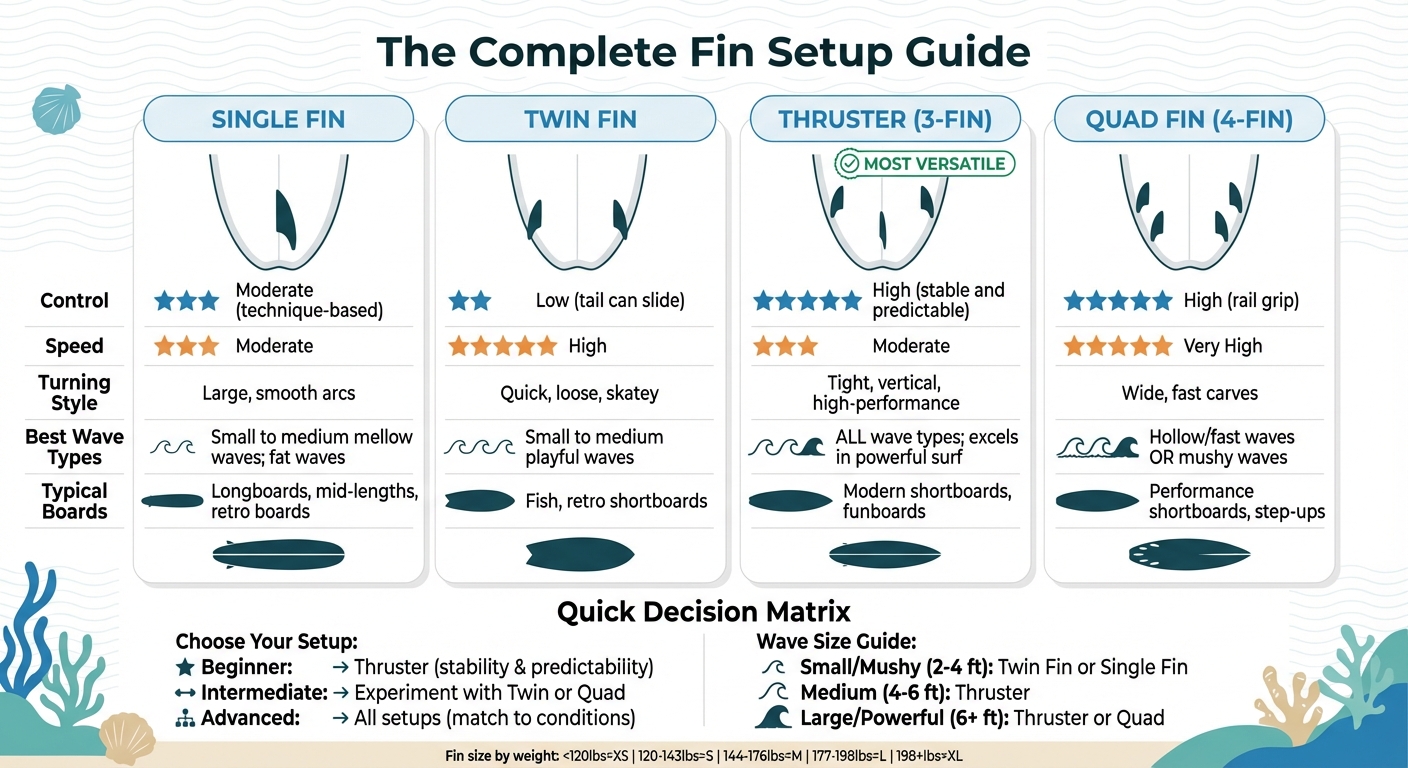
Surfboard Fin Setup Comparison Guide: Single, Twin, Thruster & Quad Fins
Which Fin Setup Is Best For A Surfboard And WHY
sbb-itb-de7840d
The 4 Main Fin Setups Explained
Getting familiar with the four main fin setups can help you choose the right configuration for your board based on the waves you’re riding. Each setup offers a distinct feel, affecting your board’s speed, turning ability, and overall stability.
Single Fin
The single fin is the classic setup, tracing its roots back to 1935 when Tom Blake, a pioneer of American surfing, attached a metal keel from a speedboat to a surfboard [8]. With just one centered fin, this setup delivers a smooth glide and long, flowing turns. It’s ideal for small, mellow waves or large, rolling ones. The minimal drag makes it easy to generate speed, though the single fin can feel slower in less steep conditions [3].
"I think every grom nowadays should have to spend some time on a single fin." - Rob Machado, Professional Surfer and Shaper [1]
However, riding a single fin requires solid technique. Control comes from your body positioning and rail work, rather than the fin itself. This setup pairs perfectly with longboards or mid-length boards, offering that timeless surfing vibe.
Twin Fin
Twin fins ditch the center fin entirely, using two fins mounted on the rails. This creates a fast, loose, and skate-like feel, perfect for playful surfing in smaller waves [4]. Mark Richards proved the potential of this setup, winning four consecutive World Championships in the late 1970s and early 1980s on twin-fin fish boards [4]. While twin fins are great for generating speed and carving quick turns, they can feel slippery during bottom turns as wave sizes increase [4].
This setup shines in small to medium, softer waves, where speed and sharp, slashy turns are the focus. Twin fins are often found on fish boards and retro shortboards, offering a fun and lively ride.
Thruster (3-Fin)
Invented in 1980 by Australian surfer Simon Anderson, the thruster setup has become the go-to choice for most surfers [8]. It combines a centered stabilizing fin with two side fins for drive, making it versatile enough for everything from small, mushy conditions to big, hollow waves. The center fin allows for tight, vertical turns and dynamic maneuvers [4].
"The thruster setup has played a huge part in the evolution of high-performance surfing, making many radical manoeuvres possible." - Barefoot Surf Travel [4]
While thrusters generate a bit more drag compared to twin or quad setups, their balance of control and maneuverability makes them a favorite for surfers of all skill levels. Most modern shortboards and funboards come equipped with this setup.
Quad Fin (4-Fin)
Quad fins blend the speed of twin fin setups with the control of thrusters. Using four fins, this design reduces drag while maintaining solid rail grip [9]. It performs well in two very different scenarios: small, mushy waves where speed is essential and big, hollow waves that demand strong down-the-line hold [9].
The rear fins provide extra traction on steep wave faces, helping you stay high in the barrel [10]. Advanced surfers often choose quads for powerful reef breaks, as the rail fins offer the grip needed to hold a high line. Quads feel fast and skatey, like twin fins, but with added control. However, they don’t pivot as tightly as thrusters, resulting in wider, faster arcs [9]. Fin placement matters here - rear fins set forward improve quick turns in smaller waves, while fins positioned further back enhance grip in larger surf [4].
Fin Setup Comparison Table
| Setup | Control | Speed | Turning Style | Best Wave Types | Typical Boards |
|---|---|---|---|---|---|
| Single Fin | Moderate (technique-based) | Moderate | Large, smooth arcs | Small to medium mellow waves; fat waves | Longboards, mid-lengths, retro boards |
| Twin Fin | Low (tail can slide) | High | Quick, loose, skatey | Small to medium playful waves | Fish, retro shortboards |
| Thruster | High (stable and predictable) | Moderate | Tight, vertical, high-performance | All wave types; excels in powerful surf | Modern shortboards, funboards |
| Quad | High (rail grip) | Very High | Wide, fast carves | Hollow/fast waves or mushy waves | Performance shortboards, step-ups |
How to Match Fin Setups to Your Board, Waves, and Skill Level
Now that we’ve covered the types of fin setups, let’s talk about how to align them with your board, the waves you’re riding, and your skill level. Choosing the right fins isn’t just about preference - it’s about understanding what works best for your specific setup and conditions. Start by knowing your board’s fin configuration, then adjust based on the waves and your experience in the water.
Check Your Board's Fin Boxes
Before buying fins, take a look at the tail of your board to figure out its fin system. If you see a single long slot, that’s a Futures box (sometimes called a "full-base" system), which secures fins with one grub screw at the front. If there are two separate plugs or a peanut-shaped box, you’re looking at an FCS setup, which uses two grub screws. FCS II, on the other hand, is a keyless system where fins click into place without screws. If you have older two-tab FCS fins, you can still use them with a compatibility kit that includes spacers and screws [5].
"The first thing you need to do before selecting fins, is to check out the bottom of your surfboard near the tail and figure out what sort of fin configuration you have." - True Ames [7]
Next, count the fin boxes. One box means a single fin setup, two are for twin fins, three indicate a thruster, four are for quads, and five allow for convertible thruster/quad setups [2]. Keep in mind that Futures and FCS systems are not interchangeable, so double-check before making a purchase [6].
Pick Based on Wave Size and Shape
Wave conditions play a huge role in choosing the right fins. For small, mushy waves (2–4 ft / 0.6–1.2 m), you’ll want fins that help you generate speed and keep things loose, as the wave won’t provide much power. Twin fins and single fins are great here because they create less drag. Quads can also work well for speed in weaker surf [6][4].
When the waves grow to medium size (4–6 ft / 1.2–2 m) and have good shape, thrusters become the go-to option. They strike a balance between speed and control, which is why they’ve been the standard for high-performance surfing for decades [7]. For large, powerful waves (6+ ft / 2+ m) or steep reef breaks, thrusters or quads are ideal. The extra fins provide the grip you need to hold your line on steep, critical faces without slipping out [5][4].
Fin rake - the angle at which fins sweep back - also matters. Upright fins with less rake help with quick pivots in tight, fast-breaking waves. On the other hand, fins with more rake (more swept-back) are better for long, drawn-out turns and add stability in bigger, slopey waves [7][1].
Match to Your Experience Level
Your skill level is another key factor in choosing fins. Beginners benefit from a thruster setup with stiffer fins, which offer stability and predictability - perfect for building confidence and learning proper technique [4][5].
As an intermediate surfer, you’ve got more room to experiment. At this stage, you’re actively engaging with the wave rather than just riding along [12]. Try quads for added speed or twins for a looser, more playful feel to refine your style. Use your weight to choose the right fin size: under 120 lbs = XS, 120–143 lbs = S, 144–176 lbs = M, 177–198 lbs = L, and over 198 lbs = XL [1][5].
For advanced surfers, fin selection becomes more nuanced. You might downsize fins in larger waves for better control or opt for larger fins in smaller, weaker conditions to generate power [12]. Advanced surfers also explore materials like carbon fiber for quick response in powerful surf or flexible constructions for a looser, more playful ride in softer waves [12][1].
Here’s a quick reference table to simplify your decision-making:
Quick Decision Table
| Board Type | Wave Conditions | Skill Level | Recommended Setup |
|---|---|---|---|
| Longboard / Mid-length | Small to medium mellow (2–5 ft / 0.6–1.5 m) | Beginner to Intermediate | Single Fin |
| Fish / Retro Shortboard | Small, playful (2–4 ft / 0.6–1.2 m) | Intermediate to Advanced | Twin Fin |
| Modern Shortboard | All conditions (2–8 ft / 0.6–2.4 m) | All Levels | Thruster (3-Fin) |
| Performance Shortboard | Hollow, fast, or mushy (2–6 ft / 0.6–2 m) | Intermediate to Advanced | Quad (4-Fin) |
| Step-Up / Gun | Large, powerful (6+ ft / 2+ m) | Advanced | Thruster or Quad |
Step-by-Step: Choosing Your Fin Setup for Bali Surf Sessions
Bali’s waves are as diverse as its culture, changing with the tides and weather. To get the most out of your surf session, it’s crucial to match your fin setup to the day’s conditions. Start by categorizing the waves into one of four types: Small (up to head high), Big (overhead and above), Fast peeling (down-the-line), or Slow peeling [3]. Once you’ve nailed down the conditions, you can fine-tune your fins to suit what the ocean’s serving up.
Here’s how to dial in your setup for Bali’s unique surf breaks.
Step 1: Check Today’s Wave Conditions
Take a good look at the waves. If they’re small and soft (2–4 ft / 0.6–1.2 m), go for a low-drag option like twin fins to maximize lift and keep things playful [3]. On the other hand, if you’re heading to Bali’s famous reef breaks like Uluwatu, Padang Padang, or Keramas - where hollow, fast-breaking waves are common - quads or thrusters are your best bet. These setups provide the rail engagement and hold needed to handle those steep, powerful walls [3][6].
Step 2: Default to a Thruster Setup
When in doubt, stick with a thruster. It’s a versatile choice that balances control and maneuverability [6][13]. If you’re tackling fast, hollow barrels, switch to a quad for reduced drag and better grip [3][6]. For larger reef breaks (6+ ft / 2+ m), both thrusters and quads offer the stability and speed you’ll need to handle the power of the waves.
Step 3: Tailor to Your Surfing Style
Your surfing style plays a huge role in fin selection. If you love long, drawn-out carves, opt for fins with a more swept-back design. Prefer tight, snappy turns? Go for upright fins with less rake [1]. If your board feels stiff, loosen it up with smaller fins or even a twin-fin setup for a more playful ride.
Step 4: Dial in Fin Size and Stiffness
Choose your fin size based on your weight:
For Bali’s powerful reef breaks, stiff fins made from materials like fiberglass or carbon fiber are ideal. They’ll hold their shape during turns and prevent the dreaded “washout” [1][3]. In softer, less critical waves, flexible fins can add a little extra spring to your ride [1].
"A fin that feels too stiff feels like it's not flexing at all. Conversely, a fin that's too soft... flexes and washes out, never really springing back effectively." – Trip Forman, Co-founder of REAL Watersports [1]
For barreling waves, look for fins with low Ride Numbers (1–4) to maximize control [1]. With the right setup, you’ll be ready to take on Bali’s legendary waves with confidence and style.
Tips for Using Different Fin Setups in Bali
Pack Multiple Fin Sets When Traveling
Bali’s waves are as unpredictable as they are world-class. What works perfectly at Uluwatu in the morning might not cut it at Canggu by the afternoon. To stay prepared, pack at least two different fin setups - a thruster and a quad set. This versatility will help you adapt to Bali's diverse surf breaks, especially if you’re riding a 5-fin board that supports both configurations [1].
Protecting your fins during travel is just as important. Wrap them in a towel or invest in a fin case to avoid damage in transit. Don’t forget a fin key and extra grub screws, especially if you’re using older FCS or Futures systems [5]. While FCS II fins offer a convenient snap-in design, having backup hardware is a lifesaver if something goes missing or breaks on a shallow reef.
Once you’ve arrived, you can fine-tune your choices further with some hands-on testing at local surf camps.
Test Fin Setups at Surf Camps
Surf camps in Bali are a fantastic way to experiment with different fin setups without committing to a purchase. Many camps, like those listed on Find Surf Camp Bali, provide rental gear, expert coaching, and even video analysis, letting you compare how quads and thrusters perform at iconic breaks like Padang Padang and Keramas [15].
This is your chance to figure out what works best for you. Test different fin sizes, materials, and stiffness levels while using feedback from coaches and video reviews to understand how each setup impacts your surfing. This hands-on experience will give you the confidence to choose the right fins when it’s time to buy.
Once you’ve nailed down your preferences, make sure your fins are up to the task of handling Bali’s challenging reef breaks.
Choose Fins That Handle Reef Breaks Safely
Bali’s reef breaks are breathtaking but unforgiving, so your fin setup needs to provide both performance and safety. Larger fins with more surface area are ideal for holding your line on steep, powerful waves [4]. For overhead reef surf, thrusters offer reliable stability, while quads deliver extra speed to help you thread hollow sections [3]. Both setups can keep you locked in when it counts, reducing the risk of a wipeout that could send you into the sharp coral below.
The material of your fins plays a big role, too. Stiff fiberglass or carbon fiber fins are a solid choice - they maintain their shape under pressure and respond quickly during critical take-offs on shallow reefs [1]. For added safety, sand down sharp edges to minimize the risk of cuts [14]. And if you’re new to reef breaks, wearing booties can offer extra protection while you build your confidence in these powerful conditions.
Conclusion
The right fin setup can completely change how your board performs in the water. By matching the fin size to your weight and tweaking it based on wave conditions, you can unlock your board's full potential. Factors like your board’s fin boxes, the type of waves you’re riding, and your skill level all play a role in finding the perfect configuration.
One of the best parts? Fins are easy to swap out, making experimentation simple and fun. Trying different setups helps you fine-tune how your board handles and gives you a better sense of what feels right for your style. The more you test, the more you’ll understand how fins influence your ride - and the more enjoyable your sessions will become.
If you're in Bali, you're in luck. The island’s diverse surf breaks are ideal for experimenting with fins. Whether you're tackling the steep reef waves at Uluwatu or cruising the mellow beach breaks at Canggu, the right fins can completely elevate your experience. Surf camps like Find Surf Camp Bali offer rental gear, coaching, and even video analysis to show how different setups affect your surfing.
Think of your fin setup as a work in progress. Every session is an opportunity to adjust and refine it as your style evolves. Keep experimenting, and you’ll find the combination that feels just right for you.
FAQs
How can I choose the best fin setup for different wave conditions?
Choosing the right fin setup comes down to the type of waves you're riding and your personal style. For smaller, softer waves (around 2-4 feet), a single fin or twin fin setup works best. These options give you a smooth, loose feel, making turns easier while helping you pick up speed in weaker surf. When you're dealing with medium, hollow waves (4-6 feet), a thruster setup strikes a solid balance between control and stability. On the other hand, if you're tackling larger, faster waves (6-10 feet or more), a quad fin setup is the way to go, offering extra speed and grip.
Not sure where to begin? A thruster setup is a reliable, all-around choice that performs well in a variety of conditions. For longboards, sticking with a single fin is usually your best bet. Meanwhile, shortboards and performance boards tend to pair nicely with thruster or quad configurations. The key is to experiment with different setups and adjust based on how your board feels under your feet. This trial-and-error approach will help you dial in the perfect setup for your style and the waves you're chasing.
What should I consider when choosing the right fin setup for my skill level?
Choosing the right fin setup hinges on several factors: your skill level, the wave conditions, and the type of board you're riding. For beginners, single or twin fin setups are often a great choice. They offer stability and are easier to manage, which helps build confidence in the water. As you progress, you might lean toward thruster or quad setups, which deliver more control for sharper turns and quicker rides.
There are other elements to consider, too. Your body weight plays a role since fins are typically sized with that in mind. Wave size also matters - smaller waves tend to work well with single or twin fins, while larger waves call for the added control of thrusters or quads. Don’t forget to check your board’s fin box system compatibility (whether it’s Futures or FCS). Even the material and stiffness of the fins can make a difference. Softer fins are forgiving and ideal for beginners, while stiffer ones provide the precision advanced surfers crave.
If you're curious about trying out different setups and want expert guidance, Find Surf Camp Bali is a great place to start. Their surf camps let you test various conditions and fine-tune your preferences with help from seasoned instructors.
How can I safely try different fin setups on Bali's reef breaks?
To safely try out different fin setups on Bali’s reef breaks, start by assessing the local surf conditions. Check for wave height (measured in feet), swell direction, and tide levels. Bali’s reef breaks are most reliable during the dry season, which runs from April through October. For beginners or those experimenting, aim for days with waves under 6 feet and mid-range tides to keep things manageable.
Pick a fin setup that suits the wave type and your experience. For fast, hollow waves, a thruster (3-fin) or quad (4-fin) setup provides more control. On the other hand, a twin-fin setup is great for softer, more playful sections. Opt for removable fins so you can tweak your setup without risking damage to your board. Start with your usual fin size and make gradual adjustments - like swapping out one fin at a time - to see how it impacts your performance.
When testing your setup, stick to a safer part of the break, such as a softer section, and always have a surf buddy close by for added safety. Keep your leash attached and pay attention to how your board handles during turns and how stable it feels. If you’re staying at a surf camp, Find Surf Camp Bali can connect you with local instructors who can provide expert tips tailored to Bali’s reef breaks.
Related Blog Posts
Subscribe to receive the latest blog posts to your inbox every week.
